
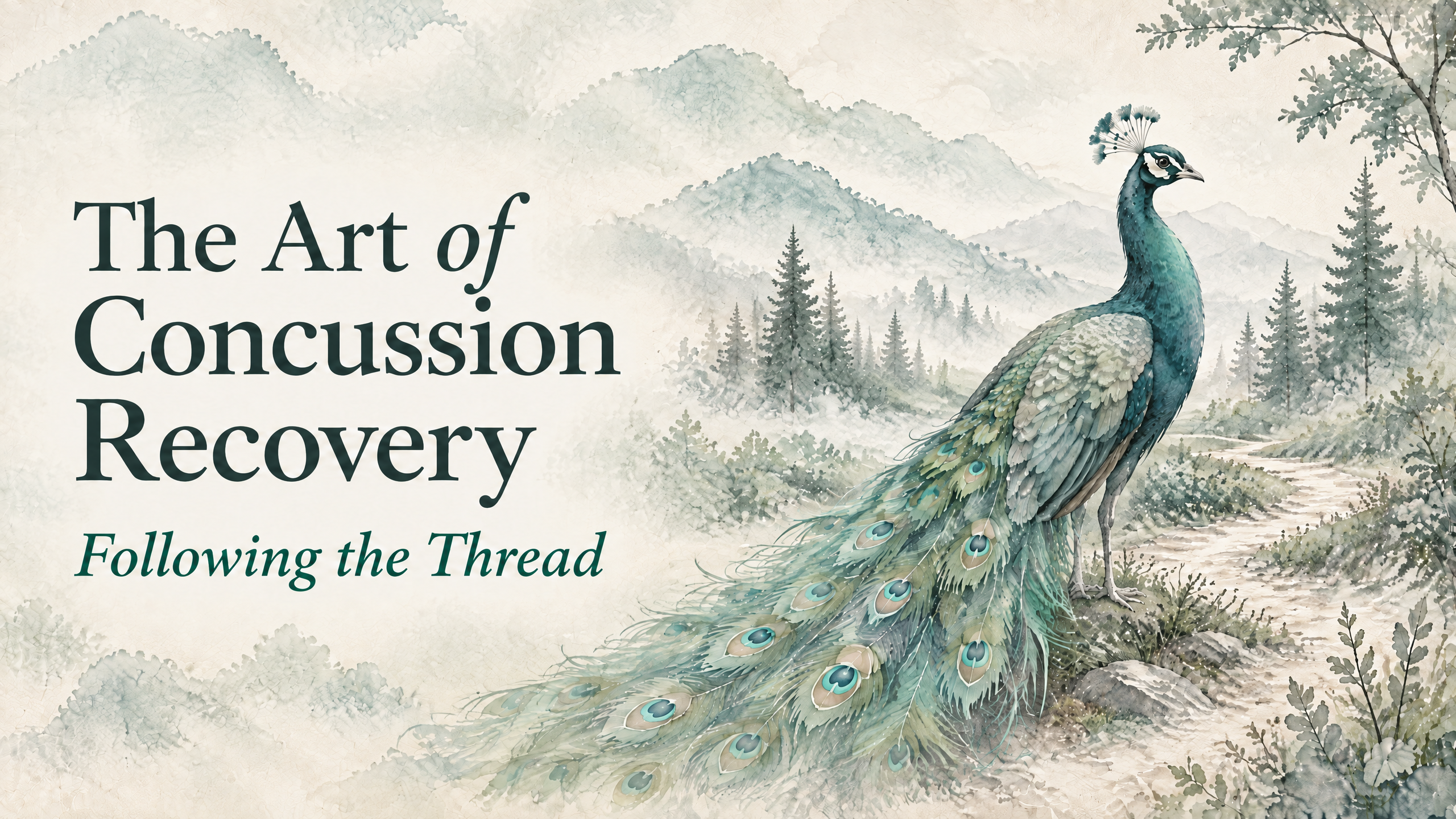
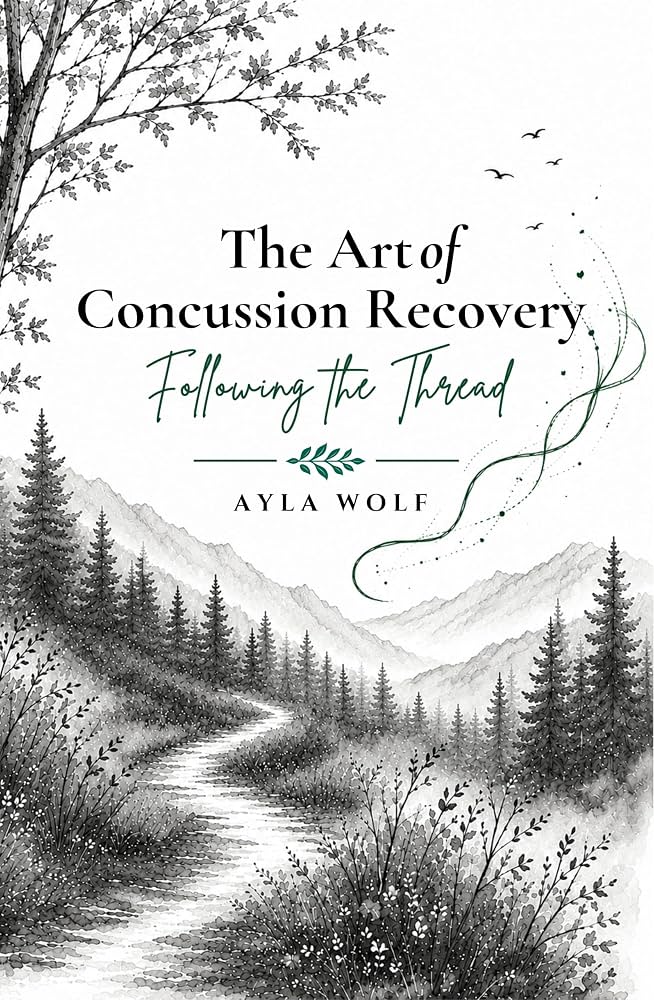
The Art of Concussion Recovery - a book for people living with the uncertainty of persistent concussion symptoms
A Thread Through the Maze
Patients rarely walk into our clinics asking for help tolerating uncertainty. They ask for help with headaches, dizziness, light sensitivity, fatigue, poor concentration, disrupted sleep, or a nervous system that no longer seems to respond predictably.
But beneath those symptoms, there is often another struggle taking place.
They no longer trust their bodies. They do not know which symptoms are warning signs, which activities are safe, or whether a difficult day means they have lost the progress they thought they were making. Many are trying to find their way back to the person they were before the injury, while quietly wondering whether that person still exists.
That mental and emotional journey is the heart of The Art of Concussion Recovery.
Following the Thread
When an Injury Disrupts a Life
Concussion does not follow the familiar story we associate with injury. The scans may be normal. The person may look fine. Yet a task that once took ten minutes may now require an hour and a long period of recovery afterward.
When symptoms persist, the injury reaches beyond headaches, balance, vision, or cognition. It affects identity, relationships, work, confidence, and the way a person imagines the future. Patients begin searching for a roadmap, only to encounter conflicting advice and a recovery process that refuses to move in a straight line.
I wrote this book for the person living inside that uncertainty.
A Different Kind of Concussion Book
The Art of Concussion Recovery is not another treatment manual. It is about the inner work of living with a brain injury: slowing down when your instinct is to push harder, listening to a body you may no longer trust, grieving what has changed, and learning that a setback does not always mean you are back at the beginning.
This is not the same as telling patients that their symptoms are psychological or that positive thinking will make them well. Skilled examination and treatment still matter. So do the physiological problems that can follow concussion. But even with good clinical care, the patient must navigate the recovery process every day, often without knowing exactly where it is leading.
A Thread Rather Than a Map
The opening chapter is called Lost in the Maze. It draws on the Greek story of Ariadne, who gave Theseus a thread to carry into the labyrinth. The thread could not show him which turn to take or protect him from choosing the wrong one. But it kept him connected to something beyond the maze—to Ariadne, to the entrance, and to the possibility of finding his way home. When the path failed him, the thread remained in his hand, quietly guiding him back.
That image captures what I wanted this book to offer. No book can provide a perfect roadmap for concussion recovery. What it can offer is a thread: language for the experience, a little guidance, and reassurance that feeling lost is not the same as being permanently lost.
Feeling lost does not mean you are lost. It simply means you have not yet found the next turn in the path.
Listen to Lost in the Maze
The book is available as a hardcover color edition, paperback, Kindle, and Audiobook.
Audio preview
Chapter One
Lost in the Maze
Listening time: 5:57
Read Chapter 1: Lost in the MazeExpand the full transcript
Chapter 1: Lost in the Maze
The hardest part of a concussion is not always the injury itself.
Sometimes it is the uncertainty that follows.
When someone breaks a bone, there is usually a plan.
An X-ray confirms the diagnosis.
A cast is applied.
Healing is measured in weeks.
Everyone understands the process.
But concussion is different.
The injury is often invisible.
The scans may be normal.
Friends and family may tell you that you look fine.
Yet something inside you knows that you are not.
You wake up tired.
The grocery store feels overwhelming.
The lights seem harsher.
Your thoughts feel slower.
You forget simple things.
You feel anxious without knowing why.
Then comes the question that quietly follows many people through recovery:
"Why am I not getting better?"
At first, most people assume healing will be straightforward.
A few days.
A few weeks.
Maybe a month.
The headache will disappear.
The dizziness will fade.
Life will return to normal.
And sometimes it does.
But sometimes it doesn't.
The weeks pass.
Then months.
And the path forward becomes harder to see.
One doctor says one thing.
Another says something completely different.
The internet offers a thousand opinions.
Friends share stories that don't match your experience.
The advice begins to contradict itself.
Exercise more.
Exercise less.
Rest.
Push through it.
Try this supplement.
Avoid that supplement.
See this specialist.
No, see that specialist.
At some point, many people discover a difficult truth:
There is no single roadmap for concussion recovery.
There is no universally prescribed path.
No treatment that works for everyone.
No box that every patient neatly fits into.
At first, this realization can feel terrifying.
Human beings like plans.
We like certainty.
We like knowing that if we follow the instructions correctly, everything will work out.
Concussion often refuses to offer that comfort.
Instead, it places us in unfamiliar territory.
A labyrinth.
A place where the path is not obvious.
A place where progress is rarely linear.
A place where the next turn is often hidden from view.
And so we begin searching.
Searching for answers.
Searching for certainty.
Searching for the person we used to be.
Searching for evidence that we are not permanently lost.
I have watched this happen thousands of times.
Patients arrive carrying notebooks filled with symptoms.
Folders full of test results.
Lists of treatments.
Questions scribbled in the margins.
Many are exhausted.
Not just physically.
Emotionally.
Spiritually.
Exhausted from trying so hard to understand what is happening.
Exhausted from searching for a map that does not seem to exist.
But over the years, I have noticed something important.
The people who eventually find their way forward are not necessarily the people who discover the perfect treatment first.
Often they are the people who learn to tolerate uncertainty long enough to continue walking.
One step.
Then another.
And another.
Not because they know exactly where they are going.
But because they trust that forward is still forward.
In Greek mythology, there is a story about a woman named Ariadne.
A hero named Theseus was sent into a labyrinth so vast and confusing that no one who entered had ever found their way back out.
Ariadne gave him a simple gift.
A thread.
Not a map.
Not directions.
Just a thread.
Something to hold onto while he searched for the path himself.
Recovery often works the same way.
No one can hand you a perfect map.
Your brain is unique.
Your injury is unique.
Your healing journey will be unique.
But what we can do is offer a thread.
A little understanding.
A little guidance.
A little hope.
Something to hold onto while you navigate the maze.
If you are reading this while feeling lost, I want you to know something.
Feeling lost does not mean you are lost.
It simply means you have not yet found the next turn in the path.
There is a difference.
And that difference matters.
The labyrinth is not the end of the story.
It is simply where the story begins.
Reflection
What if your task right now is not to see the entire path?
What if your task is simply to find the next step?
Not next month.
Not next year.
Just the next step.
And then the one after that.
A Book for the Waiting Room
Acupuncturists often hear the story behind the symptom list. We see the frustration of someone whose progress is real but uneven, and how easily people can begin to judge themselves for not recovering quickly enough.
A copy of The Art of Concussion Recovery in the waiting room can validate the invisible parts of the injury before the appointment begins. It can help a spouse or parent understand why the person they love cannot simply push through. It can also continue a conversation about pacing, self-trust, and patience after the patient leaves the clinic.
The chapters are intentionally short and accessible. Patients can read a few pages, return to them later, or open the book during a setback when they need to remember that nonlinear progress is still progress.
People recovering from concussion need skilled care. They also need something to hold onto while the next part of the path is still hidden. That is what I hope this book can become: not a perfect map, but a thread through the maze.