


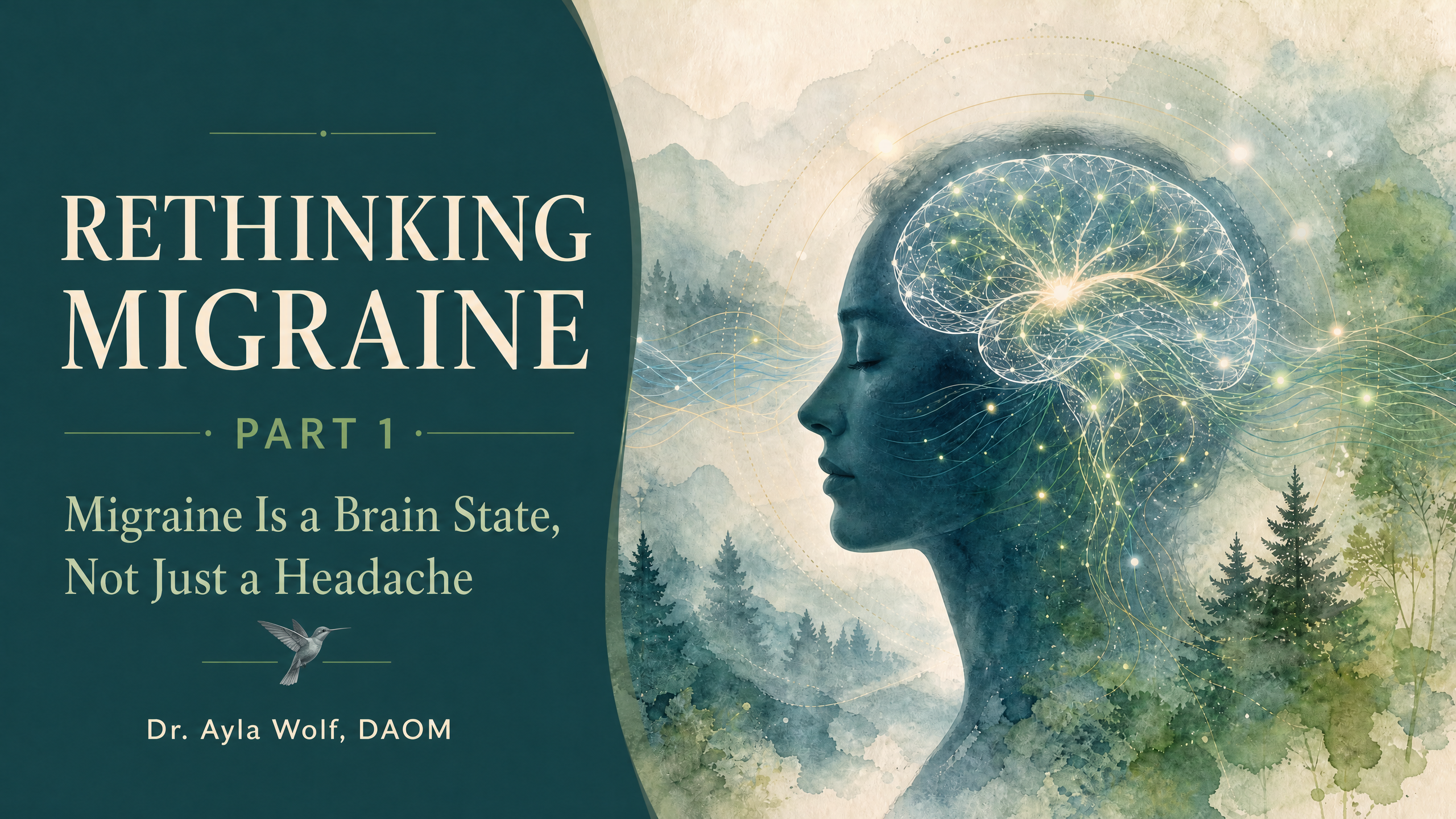
Part 1: Migraine Is a Brain State, Not Just a Headache
Migraine Is Not Just a Headache
For decades, migraines were thought to be primarily a vascular disorder—a problem of dilating and constricting blood vessels.
We now know that explanation is incomplete.
Modern neuroscience has fundamentally changed how we understand migraine. Rather than being simply an episode of severe head pain, migraine is increasingly recognized as a disorder of altered brain excitability and sensory processing. The headache is only one phase of a much larger neurologic event.
This shift in understanding has important implications for acupuncturists. If migraine is viewed only as pain, treatment naturally focuses on reducing pain. But if migraine is understood as a nervous system state, our clinical assessment—and ultimately our treatment strategies—become much broader.
The Migraine Brain Behaves Differently
One of the most interesting discoveries from migraine research is that the migraine brain functions differently even between attacks.
Many patients continue to demonstrate increased sensitivity to light, sound, smell, and other sensory stimuli during symptom-free periods. This suggests that migraine is not simply an intermittent headache disorder—it is a persistent alteration in how the brain processes sensory information.
Think of migraine as a nervous system with the volume knob turned up.
The brain isn't necessarily producing pain all the time, but it is more responsive to incoming sensory information.
A Disorder of Sensory Processing
Brain imaging studies have demonstrated structural and functional differences in multiple pain-processing regions in people with migraine.
Research has identified:
- Altered gray matter in regions involved in pain modulation
- Increased representation of the face and head within the somatosensory cortex
- Abnormal communication between cortical and subcortical pain-processing networks
- Heightened responses to light, smell, heat, and painful stimuli
Taken together, these findings support the concept that migraine represents a disorder of central sensitization and sensory hyperexcitability, rather than simply abnormal blood vessels.
The Vascular Theory Isn't Wrong—It's Just Incomplete
Patients often hear that migraines are caused by blood vessels expanding.
There is a vascular component to migraine, but modern evidence shows that vascular changes occur within a much larger neurologic process.
Activation of the trigeminovascular system leads to release of inflammatory neuropeptides such as CGRP, substance P, and neurokinin A. These substances promote vasodilation, neurogenic inflammation, mast cell activation, and sensitization of pain pathways.
In other words:
The brain drives the vascular changes—not the other way around.
Why This Matters for Acupuncturists
Viewing migraine through the lens of nervous system regulation changes the clinical conversation.
Instead of asking:
"How do I treat the headache?"
We begin asking:
- Why has this patient's migraine threshold become so low?
- What is driving central sensitization?
- Is the autonomic nervous system involved?
- Are hormones, inflammation, concussion, cervical dysfunction, histamine metabolism, or sleep contributing to increased excitability?
These questions help explain why two patients with "migraine" may require completely different treatment approaches.
This is one of the strengths of acupuncture. Rather than treating migraine as a single disease, acupuncture encourages us to identify the unique physiologic patterns contributing to each individual's symptoms.
Clinical Pearl
One of the biggest mindset shifts for practitioners is recognizing that the headache itself may represent the final stage of a neurologic process that has been developing for hours—or even days.
Many patients experience fatigue, food cravings, neck stiffness, mood changes, yawning, difficulty concentrating, or sensory sensitivity long before pain begins. These symptoms are clues that the nervous system has already entered a migraine state.
The headache is often the most visible symptom—but it is rarely where the migraine truly begins.
Key Takeaways
Migraine is increasingly understood as a disorder of altered brain excitability.
The migraine brain remains different even between attacks.
Central sensitization and abnormal sensory processing play major roles.
Vascular changes are part of migraine, but they are driven by underlying neurologic mechanisms.
Understanding migraine as a nervous system disorder helps acupuncturists develop more individualized treatment strategies.
Suggested Reading
- Goadsby PJ, Holland PR, Martins-Oliveira M, Hoffmann J, Schankin C, Akerman S. Pathophysiology of Migraine: A Disorder of Sensory Processing. Physiological Reviews. 2017.
- Charles A. The Pathophysiology of Migraine: Implications for Clinical Management. Lancet Neurology. 2018.
- Terrier LM, Hadjikhani N. Migraine: The Trigeminovascular System and Central Sensitization. 2021.
- Li K, et al. Acupuncture Modulates Abnormal Brainstem Activity in Migraine Without Aura Patients. Frontiers in Human Neuroscience. 2017.
Continue Rethinking Migraine
Next Article → Part 2: The Four Phases of Migraine—Why the Headache Is Only One Part of the Story
Continue Learning
This article is part of the series Rethinking Migraine. Subscribe to the newsletter for updates on articles, courses, and live events.
If you are looking for continuing education credits on this topic, consider my Migraine Series: A Clinical Guide for Acupuncturists available through Net of Knowledge!
Back to blog