
Live two-day continuing education seminar

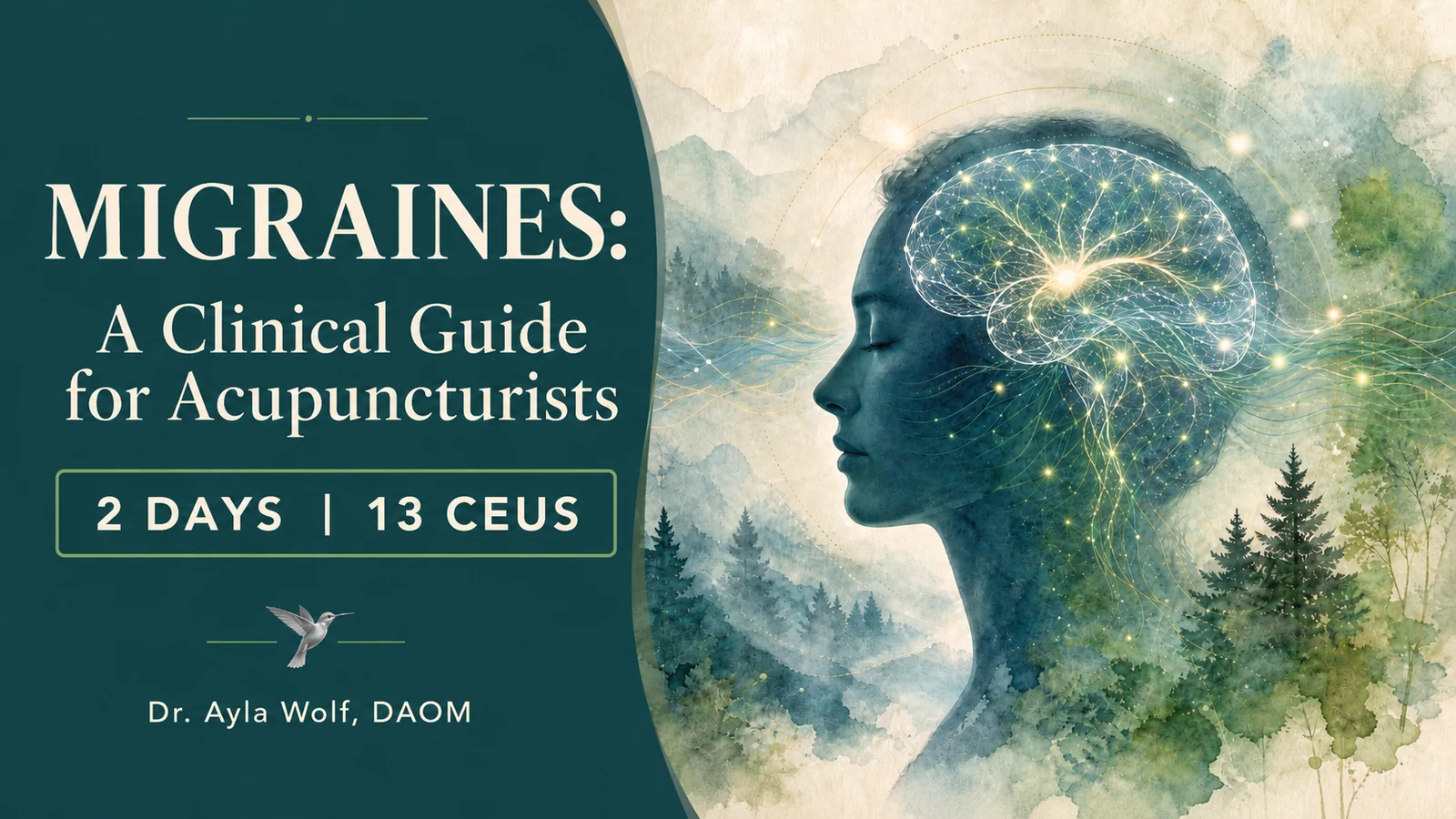
Migraines: A Clinical Guide for Acupuncturists

Go beyond treating the headache. Learn to recognize the physiology, patterns, and clinical clues that make every migraine patient different.

Register nowNovember 7-8th, 2026Bloomington, Minnesota
Explore the seminar
Migraines: A Clinical Guide for Acupuncturists workshop thumbnail
For acupuncturists who want a deeper map for complex migraine care.

Overview

Become an expert in complex migraine cases

Migraine patients can be some of the most complex—and frustrated—people who walk into an acupuncture clinic. They may have seen multiple providers, tried numerous medications, changed their diets, undergone normal imaging, and still continue to suffer.

Often, headache is only part of the picture.

Dizziness. Neck pain. Nausea. Light sensitivity. Hormonal fluctuations. Sleep disruption. Histamine sensitivity. Autonomic dysfunction. Visual symptoms. Chronic inflammation.

The challenge isn't simply knowing which acupuncture points are traditionally used for migraine. It's understanding why this particular patient is having migraines in the first place—and what may be keeping their nervous system susceptible to the next attack.

A different way of seeing migraine

This isn't just a course about acupuncture points.

Of course we'll discuss acupuncture. We'll examine acupuncture research, migraine protocols, acute and preventive treatment strategies, and ways acupuncture may influence neural networks involved in migraine.

But this workshop goes much further. Because becoming better at treating migraine requires first becoming better at understanding migraine.

Over two intensive days, we'll learn how to recognize patterns, understand the physiology behind them, and use that information to make more thoughtful clinical decisions.

What you'll explore

Build a clearer clinical framework for the patient in front of you.

Throughout the weekend, we'll connect the material to clinical reasoning and real-world cases.

01 · Foundation

Understand migraine as a neurologic process.

We'll begin by building a modern foundation in migraine science, including:

  • Migraine diagnosis and epidemiology
  • Episodic versus chronic migraine
  • The four phases of migraine
  • Migraine with and without aura
  • Visual, retinal, brainstem, and hemiplegic presentations
  • Cortical spreading depression
  • Migraine as a brain state
  • The trigeminal and trigeminovascular systems
  • Ascending pain pathways
  • Descending pain inhibition
  • CGRP and modern migraine physiology
  • Central sensitization
  • Migraine as a risk factor for other health conditions

You'll leave with a clearer understanding of what is actually happening during a migraine—not simply what the patient feels.

02 · Presentations

Learn to recognize the migraine patient in front of you.

We'll explore important migraine presentations including:

  • Vestibular migraine
  • Abdominal migraine
  • Cyclical vomiting
  • Hemiplegic migraine
  • Retinal and visual aura presentations

—and other clinical patterns that can easily be misunderstood.

When is a migraine not a migraine?

We'll discuss migraine versus tension-type headache, post-traumatic headache, cervicogenic involvement, and other presentations where diagnostic overlap can complicate treatment.

03 · Examination

Move beyond symptoms: learn what to examine.

We'll explore practical assessment strategies including:

  • Migraine tracking
  • MIDAS
  • COMPASS-31
  • Cranial nerve examination
  • Trigeminal sensory examination
  • Sensory extinction
  • Oculomotor examination
  • Vergence eye movements
  • Vestibular findings and nystagmus

The goal isn't to turn your acupuncture clinic into a neurology department. It's to help you notice more.

04 · Sensory physiology

Look beyond the headache.

Migraine is a sensory disorder. We'll explore why patients can become unusually sensitive to:

  • Light
  • Sound
  • Movement
  • Weather changes
  • Other environmental stimuli

—and what these symptoms tell us about the state of the nervous system.

Photophobia in particular offers a fascinating window into migraine physiology and the interaction between visual pathways, sensory processing, and pain.

05 · Medication literacy

Understand the medications your patients are taking.

Acupuncturists don't prescribe migraine medications—but we absolutely need to understand them.

  • Triptans
  • CGRP-targeting medications
  • Anti-seizure medications
  • Beta blockers
  • Calcium channel blockers
  • Antidepressants

We'll also examine medication-overuse headache and how medications intended to relieve migraine can, when used too frequently, contribute to chronic daily headache.

06 · Acupuncture care

Explore acute and preventive migraine care.

We'll examine both traditional approaches and contemporary research surrounding acupuncture for migraine.

  • Acupuncture as an acute migraine intervention
  • Acupuncture for migraine prevention
  • Zhao migraine protocols
  • Sun migraine protocols
  • Electroacupuncture
  • Cervical considerations
  • Non-pharmaceutical migraine strategies
  • Research examining acupuncture for migraine
  • How acupuncture may influence brain networks involved in pain modulation

Rather than simply memorizing protocols, we'll discuss why, when, and for whom different approaches may make sense.

07 · Threshold factors

Explore diet, histamine & the migraine threshold.

We'll explore how dietary, metabolic, and inflammatory factors may influence migraine susceptibility, including:

  • Anti-inflammatory and Mediterranean dietary patterns
  • Gluten
  • Gut health
  • Histamine production and clearance
  • Histamine receptors in the nervous system
  • Histamine and vestibular migraine
  • Nitric oxide
  • MTHFR and homocysteine
  • B vitamins
  • Vitamin D
  • Omega-3 fatty acids
  • Caffeine and adenosine physiology
  • Nutritional considerations for migraine prevention

The goal isn't to put every migraine patient on the same restrictive diet. It's to understand which questions are worth asking and which patterns may matter for the individual patient.

08 · Hormones

Examine one of the most important pieces of the migraine puzzle.

Migraine disproportionately affects women, and hormonal fluctuations can profoundly influence migraine threshold.

  • Estrogen and migraine
  • Estrogen dominance
  • Estrogen and progesterone fluctuations
  • The estrobolome
  • Menstrual and menstrual-related migraine
  • Endometriosis and migraine
  • Xenoestrogens
  • Estrogen metabolism and detoxification
  • DIM
  • Prostaglandins
  • Testosterone in women
  • Hormone testing
  • Nutritional support for hormone-driven inflammation
  • Male hormones and migraine

Rather than reducing hormonal migraine to “estrogen is too high” or “estrogen is too low,” we'll explore how hormonal dynamics and fluctuations interact with an already susceptible nervous system.

Who this is for

Built for acupuncturists who want to see the whole migraine picture.

This seminar is designed for acupuncturists and East Asian medicine practitioners who:

  • Regularly treat headaches or migraine
  • Want to feel more confident treating complex migraine patients
  • Want to integrate contemporary neuroscience with acupuncture practice
  • Are interested in neurological examination and clinical reasoning
  • Want to better understand migraine medications and modern migraine care
  • Want practical strategies they can bring back to the treatment room immediately

You don't need an extensive background in neurology. We'll build the concepts step by step and continually connect the science back to clinical practice.

Continuing education

Approved for 13 PDA points by NCBAHM.

Registration is now open. Reserve your place for this live workshop.

Live two-day seminar13 PDA points

Bloomington, Minnesota

NCBAHM-approved · Northwestern Health Sciences UniversityRegister for the workshop

Workshop pricing

Choose the registration category that applies to you.

Early bird pricing until October 15th.

Register now

Licensed practitioners

Early bird$699
Full price$799

Students

Early bird$499
Full price$549
Dr. Ayla Wolf, DAOM

Your instructor

Dr. Ayla Wolf, DAOM

Dr. Ayla Wolf is a clinician, educator, researcher, and international lecturer specializing in neurological rehabilitation and complex headache and concussion care.

Her teaching brings together contemporary neuroscience, clinical examination, acupuncture research, and nearly two decades of patient care to help practitioners understand not only what they are treating, but why the presentation may be occurring.

You'll leave with more than migraine facts.

My goal isn't for you to walk away knowing more terminology. It's for you to return to your clinic on Monday and notice things you didn't notice before.

To recognize when someone's “tension headache” may actually be migraine. To ask about medication frequency when a patient's episodic headaches suddenly become daily. To recognize the patient whose dizziness may be part of vestibular migraine.

And to build acupuncture treatments from a deeper understanding of the nervous system in front of you.