

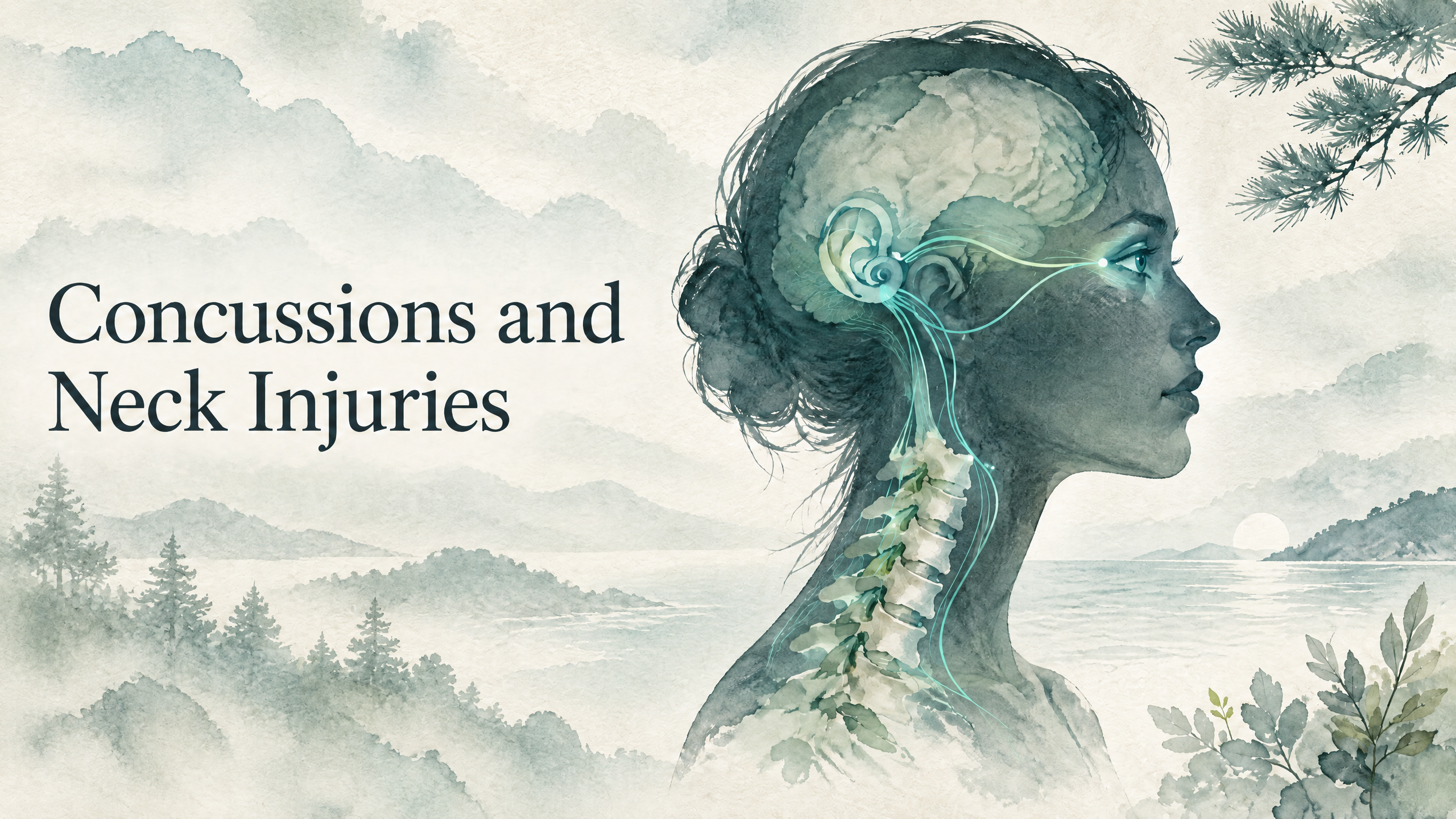
Why headaches, dizziness, visual symptoms, and poor balance may require a closer look at the cervical spine
Concussion and Neck Injury Often Travel Together
When a patient develops headaches, dizziness, blurred vision, light sensitivity, and poor balance after a car accident, fall, or sports injury, the obvious assumption is that every symptom is coming from the concussion.
And sometimes it is.
But the same forces that move the brain inside the skull also place enormous stress on the cervical spine. The joints, ligaments, muscles, and sensory receptors of the neck can all be injured during the same event. This means the patient may have a concussion, a traumatic neck injury, or both.
That leaves us with a clinically important question: How much of the patient's current symptom burden is coming from the brain, how much is coming from the neck, and how much is being created by the interaction between the two?
The Symptoms Do Not Tell You Where They Came From
Traumatic neck injuries can produce many of the same symptoms associated with concussion:
- Headache or pressure in the head
- Dizziness, rocking, floating, or a sense of being off balance
- Poor postural stability
- Visual fatigue or blurred vision
- Difficulty judging depth or spatial orientation
- Light sensitivity
- Nausea or symptom provocation with head movement
- Difficulty tolerating visually busy environments
The symptom list alone cannot tell us which system is responsible. Dizziness is a perfect example. One patient may be describing true rotational vertigo. Another may mean lightheadedness or presyncope. A third may feel as though they are rocking, floating, swimming, or walking on an unstable surface.
Those experiences may involve the vestibular system, visual system, autonomic regulation, migraine physiology, the cervical spine, or several systems at the same time. If we simply write down dizziness and move on, we miss the most useful part of the history. What does the dizziness actually feel like, and what reliably triggers it or changes it?
The Neck Is Part of the Balance System
We tend to think about the neck as a mechanical structure. It holds up the head, allows us to turn and look around, and frequently becomes painful after trauma.
But the neck is also a sensory organ.
Muscles and joints in the upper cervical spine contain a dense network of muscle spindles and joint mechanoreceptors. These receptors continually tell the brain where the head is positioned in relation to the body and how it is moving through space. The brain compares that information with signals arriving from the visual and vestibular systems.
In order to feel stable, those systems need to agree. The eyes report where we are relative to the visual environment. The vestibular system reports head movement and orientation relative to gravity. The cervical proprioceptive system reports where the head is positioned relative to the trunk. Balance emerges from the integration of all three.
When the Signals No Longer Match
Following whiplash or another traumatic neck injury, sensory information coming from the cervical spine may become distorted. Injured joints, guarded muscles, altered movement patterns, and hyperactive mechanoreceptors can all change the quality of the signal reaching the brain.
Now the visual system may be reporting one thing, the vestibular system another, and the neck something slightly different.
The result can be dizziness, unsteadiness, visual fatigue, altered depth perception, poor balance, or difficulty coordinating head and eye movements. This is one proposed explanation for cervicogenic dizziness.
That does not mean every patient with neck pain and dizziness has cervicogenic dizziness. There is no single definitive test, and the diagnosis requires other vestibular, neurological, vascular, migraine-related, and medical causes to be considered. It is also entirely possible for a patient to have both vestibular dysfunction and altered cervical proprioception after the same injury.
That distinction is important clinically.
The Trigeminocervical Connection
The relationship between the neck and post-traumatic headache is equally important. Sensory information from the upper cervical nerves converges with trigeminal input in the trigeminocervical complex. Because those signals meet within shared neural pathways, pain arising from cervical structures can be felt in the occiput, temple, forehead, or behind the eye.
This helps explain a pattern clinicians see all the time: pain begins in the upper neck or base of the skull and travels forward toward the eye.
Neck pain does not automatically make a headache cervicogenic. Migraine and post-traumatic headache commonly include neck pain and muscle tension. The cervical hypothesis becomes more compelling when the headache changes predictably with neck movement, posture, restricted range of motion, or pressure over specific cervical structures.
What Should We Be Asking
A general concussion questionnaire may tell us that the patient has headaches or dizziness. It may not tell us whether the neck is changing those symptoms.
A few targeted questions can reveal a much more interesting pattern:
- Did the neck pain or stiffness begin at the time of the injury?
- Do the headaches begin in the neck or worsen when the neck becomes tense?
- Does the head feel unusually heavy or difficult to support?
- Does pain travel from the neck toward the occiput, temple, or eye?
- Do dizziness, neck pain, or headaches change when the head is turned or held in a particular position?
- Is cervical rotation, flexion, or extension restricted or symptom provoking?
- Is there jaw pain, clenching, clicking, or a change in symptoms with chewing or opening the mouth?
Those answers do not establish a diagnosis. They do tell us where to look next.
What Can We Test in the Clinic
Before performing local needling, manual treatment, or cervical exercises after significant trauma, the patient must first be screened for fracture, instability, spinal cord involvement, progressive neurological loss, vascular symptoms, and other red flags that require medical evaluation.
Once serious pathology has been excluded, the examination can begin asking a more functional question: Does changing the position or sensory input of the neck change the patient's symptoms or performance?
Cervical range of motion is a starting point, but it is not the whole examination. I also want to know whether the patient can accurately sense head position, coordinate the eyes and head, and maintain balance when visual information is removed.
Joint position error testing can be performed with a laser target to see whether the patient can return the head accurately to center after movement. Head-eye following can reveal whether the neck moves smoothly with the visual target or whether the eyes begin compensating when cervical motion reaches a barrier. Smooth pursuits can be compared with the head in neutral and in rotated positions. Balance can be measured under standardized conditions.
A change in one of these tests does not prove that the neck is the source of the patient's symptoms. But when the same symptom or performance deficit changes predictably with neck position, cervical sensory input, or treatment, the finding becomes more clinically meaningful.
The Jaw May Be Part of the Story
The jaw is another structure we should not ignore. Jaw movement is functionally coupled with the upper cervical spine, and many patients clench or guard after trauma. Some patients notice that opening the jaw changes facial sensation, headache, dizziness, or balance. Asking about jaw tension and jaw clenching becomes an important part of the intake, and palpation of the muscles of mastication can provide further data on jaw soreness and pain.
What This Changes About Acupuncture Treatment
If the examination suggests that the neck is contributing to the patient's symptoms, acupuncture can become part of a broader sensorimotor strategy. The goal is not simply to relax tight muscles. We are also attempting to change the quality of sensory information entering the nervous system from the injured region.
Point selection should reflect the examination. A patient whose dizziness and visual control change with neck position may require a different emphasis than a patient whose primary problem is a cervicogenic headache with restricted rotation. The tissue irritability, mechanism of injury, neurological findings, and depth of local needling all matter.
The Neck Should Not Be Treated in Isolation
None of this means that persistent post-concussion symptoms should be reduced to a musculoskeletal problem. Concussion recovery may involve vestibular, oculomotor, autonomic, migraine, sleep, mood, and cognitive factors in addition to cervical injury.
But the cervical system is one of the places where those problems can intersect. It can influence pain, gaze stability, spatial orientation, and balance. If we never assess it, we may leave an important source of abnormal sensory input untreated.
The more useful question is not whether a symptom belongs to the brain or the neck as though we must choose one. The better question is which systems are contributing to this patient's presentation, how they are interacting, and which findings change when we intervene.
The Bigger Picture
The same traumatic event can injure the brain and the neck. The symptoms can overlap so completely that history alone may not separate them.
That is precisely why the neck deserves a place in the concussion examination. When we assess cervical motion, proprioception, head-eye coordination, balance, and jaw involvement, we begin to see whether the cervical system is simply painful or whether it is actively changing how the patient experiences the world around them.
And for an acupuncturist, that distinction can completely change the treatment plan.
Continue Learning
Traumatic Neck Injuries is part of my Concussion Treatment Series available online. The course expands on cervical sensory integration, functional examination, balance testing, acupuncture strategies, cervical proprioceptive retraining, and multidisciplinary care for patients with concussion and whiplash-associated symptoms.
Explore Concussion Course 3Traumatic Neck InjuriesSuggested Reading
- Devaraja K. Approach to cervicogenic dizziness: a comprehensive review of its aetiopathology and management. European Archives of Oto-Rhino-Laryngology. 2018;275:2421-2433. doi:10.1007/s00405-018-5088-z.
- Treleaven J. Dizziness, unsteadiness, visual disturbances, and sensorimotor control in traumatic neck pain. Journal of Orthopaedic and Sports Physical Therapy. 2017;47(7):492-502. doi:10.2519/jospt.2017.7052.
- Schneider, K. J., Meeuwisse, W. H., Palacios-Derflingher, L., & Emery, C. A. (2018). Changes in Measures of Cervical Spine Function, Vestibulo-ocular Reflex, Dynamic Balance, and Divided Attention Following Sport-Related Concussion in Elite Youth Ice Hockey Players. J Orthop Sports Phys Ther, 48(12), 974–981. doi:10.2519/jospt.2018.8258
- Patricios JS, Schneider KJ, Dvorak J, et al. Consensus statement on concussion in sport: the 6th International Conference on Concussion in Sport Amsterdam 2022. British Journal of Sports Medicine. 2023;57:695-711. doi:10.1136/bjsports-2023-106898.